
CURRENTLY QUERYING MY DEBUT NOVEL, THE PLACES WE GO TO DISAPPEAR
THE PLACES WE GO TO DISAPPEAR
A women's upmarket contemporary fiction novel by Jasmine Saba
97,000 WORDS · 54 CHAPTERS · PRAGUE + PENNSYLVANIA · COMPLETE MANUSCRIPT
STATUS: Currently querying
Who are you
when no one around you
knows who you’ve been?
The short version
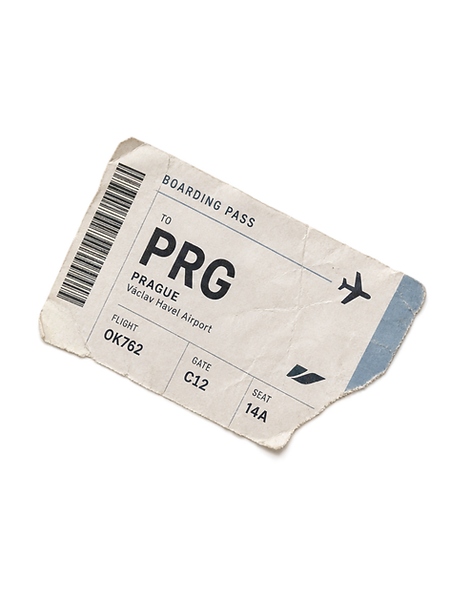
At forty, Althea arrives in Prague with no return ticket and no real plan beyond not being in Pennsylvania.
On her first night, she stops in front of a riverside projection of an ugly blue bar she’s certain she’s seen before. She remembers the colours. She remembers how it makes her feel. She just can’t remember why.
Then she meets Mneme, “Meme,” a Czech-Greek musician in a nine-colour patchwork jacket who helps her out of an uncomfortable situation, walks her back to her hostel and, eight minutes after leaving, finds himself walking straight back again.
One night becomes several. Several become a routine.
There are long walks through Prague, arguments about whether buildings remember people, a hand-drawn map made from the strange things Althea notices, a best friend six time zones away who can hear a lie through the phone, and a relationship developing at exactly the wrong time.
Except maybe it isn’t.
The Places We Go to Disappear is about leaving, returning, remembering and learning that starting over doesn’t always mean becoming someone new.
Sometimes it means finding your way back to the person you were before you started making yourself smaller.
The file
TITLE
The Places We Go to Disappear
AUTHOR
Jasmine Saba
CATEGORY
Women’s Upmarket Contemporary Fiction
LENGTH
Approximately 97,000 words
CHAPTERS
54
POV
First person present, primarily
Althea and Meme, with selected Cato chapters
PRIMARY SETTINGS
Prague, Czech Republic
Pennsylvania, USA
STATUS
Complete manuscript, currently querying
ROMANTIC THREAD
Slow burn, mutual yearning, considerable pining and an unreasonable amount of restraint
ALSO INSIDE
Female friendship, marriage, memory, family history, identity, music, starting over and learning how to choose again
FORMAT
Standalone novel with potential for connected companion stories
The things she shouldn't remember.

On Althea’s first night in Prague, enormous artworks are projected across a concrete wall beside the river. She watches one image disappear into another until a photograph of an ugly blue bar brings her to a complete stop.
There’s nothing beautiful about it. The walls are blue, the stools alternate between red and orange, and the colours seem to fight each other. Althea dislikes it immediately. The problem is that she also knows it.
Not in the vague way something can feel familiar. Her body recognises the room before her mind can place it. She knows the colours and the arrangement. She’s certain she’s seen the exact image before, even though she can’t remember where.
That certainty becomes a quieter mystery beneath the rest of the novel. As Althea moves through Prague, other fragments begin surfacing through books, colours, objects and places that seem to belong to memories she can’t quite reach.
Prague was supposed to be somewhere she’d never been.
Something in her remembers otherwise.

What will you become without him?
The wanting starts early...
This isn’t the kind of slow burn where nobody seems particularly interested until page 300.
The attraction is there almost immediately.
So is the pining, and the yearning.
And the inconvenient awareness of hands, mouths, shoulders, knees, eye contact and approximately three inches of empty space between two people who would both very much like it not to be there.
What keeps them apart isn’t lack of chemistry.
It’s choice.
Althea is still married when she meets Meme. She’s only beginning to understand the life she’s been living, and Meme refuses to let something real between them become another decision made while she’s trying to escape something else.
This doesn't improve the situation.
For readers who love the emotional tension of a slow burn romance novel, there’s plenty of that here. But the romantic thread works because it sits inside a larger story about a woman learning to trust her own choices again.
The wait isn’t the story.
The wanting is.

25 years of Cato
Long before Prague, there was Cato...
Althea and Cato have known each other since they were fifteen.
Twenty-five years is long enough to know which questions not to ask, which ones absolutely need asking and exactly what it means when your best friend says a man’s nickname in a slightly different voice.
Their friendship has survived adolescence, terrible apartments, careers, marriage, grief, distance and the gradual ways adulthood can pull two people into lives neither planned.
Cato is funny, blunt, fiercely protective and occasionally so convinced she knows what Althea needs that she has to learn the same lesson as everyone else in this book.
Love doesn’t give you the right to choose for someone.
For readers who collect books about female friendship, Althea and Cato aren’t there to support the romantic plot.
Their relationship is one of the book’s central love stories in its own right.

Starting over, without becoming someone else.
Althea doesn’t arrive in Prague and suddenly become fearless. She’s still forty, still married, still highly capable at work and far less certain when the decision belongs entirely to her. She’s also carrying years of habits she hasn’t yet recognised as fear.
Starting over in The Places We Go to Disappear isn’t a clean break between one version of a woman and another. It happens quietly, through choices that would barely register to anyone else. Althea begins buying things simply because she likes them, taking her time without checking whether someone is waiting, saying no without preparing for the reaction and remembering parts of herself she’d gradually stopped making room for.
For readers drawn to books about starting over, this is less about reinvention than reclamation. Althea doesn’t need Prague to turn her into somebody new. She needs enough distance from the life she’s been living to hear what she actually wants again, and enough freedom to believe that wanting it is reason enough.


by the numbers
97k
Words, approximately
9
Colours in a patchwork jacket
1
Wooden bear
of questionable character
54
Chapters
8
Minutes between Meme leaving Althea at her hostel and Althea calling him back
A lot
of pining
3
POV Voices
1
Hand-drawn map built from the things Althea actually notices
An unreasonable amount
of restraint
25
Years of Althea and Cato
1
Dentist sign with deeply threatening energy
4
Extra pastries bought after Althea takes one bite and declares the first one “unfair”
Content Note The Places We Go to Disappear contains themes and depictions of coercive control, emotional abuse, threatened violence, infertility, grief, traumatic loss and trauma-related memory difficulties.
How it started
This started as a dream
Not as an idea I had before bed or something I slowly pieced together afterwards. The first part of The Places We Go to Disappear actually arrived while I was asleep.
There was a woman alone in Prague at night. A walkway beside the river. Huge pieces of art being projected across a wall. One image she recognised but couldn’t remember seeing before. Then a man approaching from the opposite direction in a patchwork jacket while three drunk men came up behind her.
I could see the colours. The streets. The strange familiarity of the image. I knew there was fear between them at first, then attraction, conversation and something much bigger beginning underneath it.
I woke up and wrote down everything I could remember before it disappeared.
Then I went back to sleep, and the story kept going.
More scenes came. More conversations. More of Prague. The characters started arriving with histories I hadn’t consciously built yet, and what began as one unusually vivid dream slowly became The Places We Go to Disappear.
A lot changed while I wrote it. The story grew far beyond what I first saw that night.
But the wall, the projection, the patchwork jacket and the feeling that Althea had somehow been here before are still where it begins.

